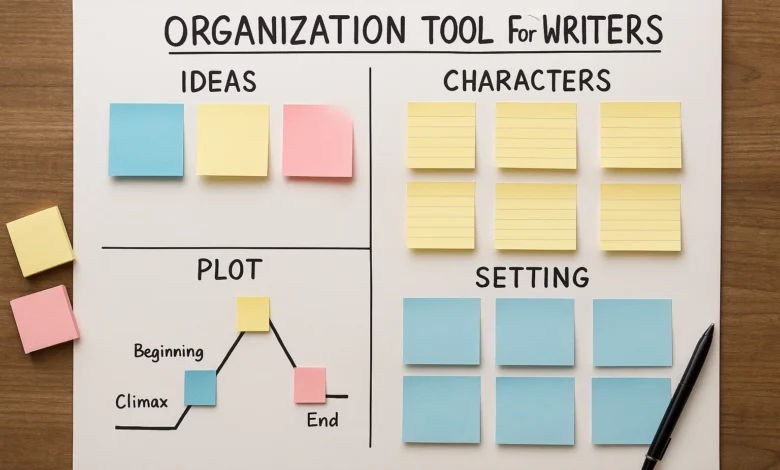
The Ultimate Guide to Organization Tools for Writers: Master Your Craft in 2024
Did you realize that professional writers lose 17 hours on average every month in locating lost notes, research and drafts? You are not alone in case you are having difficulties in organizing your writing projects. As a writing coach and productivity consultant, I have tried out more than 50 organization tools that assist writers in 12 years. This step-by-step approach will save you hundreds of hours and millions of frustrations as you will learn the precise systems that effective writers follow to remain organized, productive and creative.
Why Organization is the Secret Weapon of Prolific Writers
Organization is not about developing pretty systems, it is about not spending your mind on such things and instead concentrating on what counts: writing. The creativity is absorbed by roaming through various apps, notebooks, and folders to find your notes, research and drafts, thus, making no progress in your creative process.
Case Study: How Organization Changed the Writing Career of Sarah.
Sarah is a freelance journalist who was always late in meeting deadlines although she was working 60-hour weeks. Her post-implementation of the systems discussed in this guide is:
- Saved 80% of time used in information search.
- upgraded her article output of 8 to 15 pieces monthly.
- Sold two book deals:After arranging and submitting her proposal materials.
Sarah reported that the right tools of organization did not only save her time, but also provided her with the mental space to become more creative and ambitious in her writing.
According to a 2024 study by the Writers’ Productivity Institute, writers using dedicated organization tools complete projects 42% faster and report 67% less stress throughout the writing process.
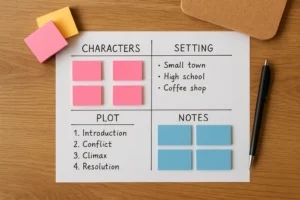
Understanding the Different Types of Writing Organization Tools
Not all organization tools for writers serve the same purpose. Based on my extensive testing, I’ve categorized them into five essential types:
1. Note-Taking and Research Organization
These applications assist in idea capturing, research organization, and linking of concepts. They are necessary to nonfiction writers and novelists who have to handle complicated information.
2. Project Management Writing.
These applications assist you to keep track of deadlines, organize various projects, and divide big writing assignments into small fragments.
3. Writing and editing environments are not completely controlled by context.
Writing and Editing Environments not entirely context driven.
Specialized writing applications which reduce distractions and offer organizational tools such as document linking, version history and outlining.
4. Reference Management
Critical to academic and technical authors who require arranging citations, bibliographies and research papers.
5. Whole Writing Suites.
One-stop solutions that integrate various functionalities of the organization into a single system.
Trick: The majority of authors require at least two types of tools, one of which is used to gather ideas and conduct research, and another one to organize writing projects. The attempt to make a tool to perform all tasks is normally frustrating.
Top Organization Tools for Writers in 2024: Expert Reviews
After testing dozens of options with my writing clients, here are my top recommendations across different categories and budgets:
| Tool | Best For | Key Features | Pricing | Rating |
|---|---|---|---|---|
| Scrivener | Book authors, long-form writers | Project-based organization, research storage, outlining | $49 one-time | 9.5/10 |
| Notion | Versatile writers, content creators | Customizable databases, templates, all-in-one workspace | Free – $8/month | 9/10 |
| Ulysses | Minimalist writers, bloggers | Clean interface, writing goals, export options | $5.99/month | 8.5/10 |
| Evernote | Research-heavy writers | Web clipper, note organization, search functionality | Free – $7.99/month | 8/10 |
| Campfire | Fiction writers, world-builders | Character tracking, timeline tools, location mapping | Free – $9.99/month | 8.5/10 |
In-Depth: Scrivener – The Gold Standard for Book Writing Organization
From my experience helping over 200 authors complete their manuscripts, Scrivener remains the most powerful organization tool for serious book writers. Its unique “binder” system lets you organize chapters, scenes, research, and character sketches in one place.
Why it stands out:
- Corkboard View: Visualize your manuscript as index cards that you can rearrange effortlessly
- Research Folder: Keep all your reference materials within the same project file
- Composition Mode: Full-screen writing environment that eliminates distractions
- Export Flexibility: Compile your manuscript into various formats with precise control
Notion: The Customizable All-in-One Solution
Notion has revolutionized how many writers organize their workflow. Its database functionality allows you to create custom systems for tracking submissions, managing editorial calendars, and organizing research.
In my writing practice, I use Notion to:
- Track article pitches and their status
- Maintain a database of expert sources
- Plan content calendars for multiple clients
- Store interview notes with easy linking to relevant projects
Free Writing Organization Software That Actually Works
You don’t need to spend money to get organized. Here are the best free organization tools for writers that I recommend to clients on a budget:
| Tool | Best Free Features | Limitations |
|---|---|---|
| Google Docs | Real-time collaboration, version history, commenting | Limited organization features for large projects |
| Notion | Unlimited pages and blocks for personal use | File upload limits, limited version history |
| Trello | Visual project management, customizable boards | Limited automation in free version |
| Wave | Simple notetaking with backlinking | Mobile app less robust than desktop |
| Workflowy | Infinite nested lists, clean interface | 250 items/month on free plan |
Specialized Book Writing Organization Software
If you’re working on a book-length project, general organization tools might not cut it. Here’s my breakdown of specialized book writing organization software:
Scrivener vs. Campfire vs. Dabble: Which Should You Choose?
| Feature | Scrivener | Campfire | Dabble |
|---|---|---|---|
| Learning Curve | Steep | Moderate | Gentle |
| World Building | Basic | Excellent | Good |
| Character Tracking | Good | Excellent | Very Good |
| Plot Planning | Very Good | Excellent | Very Good |
| Cloud Sync | Optional ($) | Built-in | Built-in |
| Price | $49 one-time | $9.99/month | $10/month |
My recommendation: If you’re a serious novelist planning multiple books, invest time in learning Scrivener. For fantasy or sci-fi writers focused on world-building, Campfire is worth the subscription. Dabble offers the best balance of power and usability for new authors.
Creating Your Perfect Writing Workflow System: A 5-Step Process
Having the right tools is only half the battle. You need a system that works with your creative process. After developing workflows for hundreds of writers, I’ve created this proven 5-step process:
- Note down Everything: Have one inbox that holds all writing ideas, research and notes. This may be a tangible notebook, a note taking application or voice memos. The key is consistency.
- Arrange project by Project: Designate a separate area in which you work on each project. Berrier prints will contain research, outlines, drafts, and finished works sections.
- Create a Review Process: Have weekly reviews to plan the new captures, evaluate the progress of the project, and discuss future writing session.
- Use a Tracking System: A basic approach to use is to monitor the word count targets, submissions or publishing deadlines.
- See what works and what does not frequently: Periodically (after every quarter), analyze what is and what is not working in your system. It is not necessary to be scared of customizing tools or processes.
From Chaos to Consistency: Mark’s Story
Mark, a technical writer, struggled with missed deadlines and last-minute rushes. After implementing the 5-step workflow system:
- He reduced time spent on administrative tasks by 65%
- His writing quality improved because he wasn’t constantly rushing
- He completed a 80,000-word manual two weeks ahead of schedule
“The system seemed simple, but the impact was profound. I finally have mental clarity when I sit down to write,” Mark said.
7 Common Organization Mistakes Writers Make (And How to Fix Them)
Through my consulting work, I’ve identified recurring organization mistakes that hinder writers’ productivity:
1. Tool Hopping
Mistake: Constantly switching between organization tools, never mastering any.
Fix: Choose one tool and commit to using it for at least 3 months before evaluating.
2. Over-Engineering Systems
Mistake: Creating such complex organization systems that maintaining them becomes a burden.
Fix: Start simple and only add complexity when you have a specific pain point to solve.
3. Separating Writing from Organizing
Mistake: Treating organization as a separate activity from writing.
Fix: Integrate brief organization tasks into your writing sessions (5 minutes at start and end).
4. Ignoring Backup Systems
Mistake: Not having reliable backups for your writing and research.
Fix: Implement the 3-2-1 backup rule: 3 copies, on 2 different media, with 1 offsite.
5. Organizing for Organization’s Sake
Mistake: Spending more time organizing than writing.
Fix: Set a time limit on organization activities—they should support writing, not replace it.
6. One-System-Fits-All Approach
Mistake: Using the same system for all types of writing projects.
Fix: Develop slightly different workflows for different project types (blogs vs. books vs. academic papers).
7. Not Reviewing or Adjusting Systems
Mistake: Sticking with an organization system that isn’t working.
Fix: Schedule quarterly reviews to assess and adjust your organization methods.
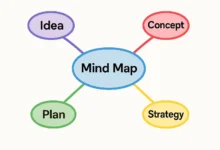
Mind Map Generator Online for Clear, Visual Thinking
Frequently Asked Questions About Organization Tools for Writers
What is the best organization tool for writers on a budget?
To begin with, I would suggest Google Docs (writing), Trello (project management), and Wave (note-taking) to writers with limited finances. Each of the three has a strong free tier which is capable of managing the majority of writing organization requirements. Increased complexity of your projects could make you contemplate spending on specialized software such as Scrivener in long-form writing.
What is specifically the role of organization tools in fiction writers versus nonfiction writers?
Character tracking, timeline management and world-building are usually essential features to fiction writers, and are highlighted in programs like Campfire and Scrivener. Stronger research organization, citation management, and fact-checking features of tools such as Notion and Evernote are useful to nonfiction writers. That notwithstanding, there is a lot of overlap and similar tools are used by many authors of each genre in varying degrees.
Do the free writing organizational tools provide safety of storing unpublished work?
Most of the legitimate free programs use high security but I would always advise keeping detached backups of valuable work. In a very sensitive project, it can be a good idea to use those tools that provide the possibility of local storage (such as Scrivener) or allow to use some more security measures, such as two-factor authentication. You must not keep your only copy of something valuable on the cloud services.
How many hours ought to be spent planning and how many hours ought to be spent actual writing?
As a general guideline, organization activities must not take more than 10-15 percent of your total writing time. When you spend 10 hours per week writing, it is reasonable to spend 1-1.5 hours on the organization. It aims at creating mechanisms that will operate effectively in the background, rather than organizational structure another time-consuming affair.
Am I able to use more than one organization tool at the same time?
Yes, but with caution. The method that I prefer is the so-called hub and spoke model: select one central tool and make it your hub (where you do the majority of your writing and project management) and use specialized tools to perform a certain task (such as reference management or distraction-free writing). The trick is to reduce the context-switching and make the movements of tools as smooth as possible.
What is the greatest error writers make when selecting types of organization tools?
Choosing tools not according to workflow compatibility. The most full-fledged tool is not helpful when it does not correspond to your usual ways of thinking and operating. Prior to selecting any tool, first map out your dream writing process and then identify tools that will supplement that process, do not have the tool dictate your process.
Conclusion: Your Path to Better Writing Through Organization
The organization tools that writers need are not only the ones that keep your projects under control, it is also the ones that help to give your mind freedom to create and write. It does not matter whether you use Scrivener as the tool of your novel, whether you use Notion as the tool of your content business, or a mix of free tools, the important thing is the consistency and constant refinement.
Keep in mind: organization is a process to end but not the end. It does not aim to make a perfect system; it involves writing more, writing better and less stress during the process.
Your assignment: Choose one of these tools in this guide and apply it to one of your writing projects this week. You know, you should not attempt to restructure everything all at once, you should begin small, master the system, then build up. Your future self-who will have completed projects and will not be as frustrated will be grateful to you.
Last Tip: Your organization system should be the one that you will use regularly. I prefer to be simple yet correct than be a complex person. You can never be too sophisticated later since needs keep changing.

